

Why More Data Hasn't Made Your Business Smarter
Picture a mid-size company - call it Northfield Supply, a hypothetical composite, not a real client - with a data warehouse, a Power BI workspace, a CRM, and three years of steadily growing dashboards. Marketing has a dashboard. Sales has a dashboard. Finance has a dashboard. Nobody in the Monday leadership meeting agrees on how many active customers the company actually has.
That's not a hypothetical edge case. It's the default outcome of adding data without adding trust.
Most companies don't have a data shortage. They have a trust shortage, and no amount of new dashboards, new tools, or new AI features fixes that on its own. If anything, each new layer built on top of an ungoverned foundation makes the disagreement louder and harder to untangle.
Key Takeaways
- Adding more data sources or dashboards doesn't resolve decision-making gaps - it usually multiplies them, because each new report inherits whatever inconsistencies already exist upstream.
- The real bottleneck is almost never data volume. It's whether teams share the same definitions, relationships, and ownership for the metrics they're all reporting on.
- AI features don't fix an ungoverned data foundation - they query it, faster and with more apparent confidence, which makes existing gaps more visible and more costly.
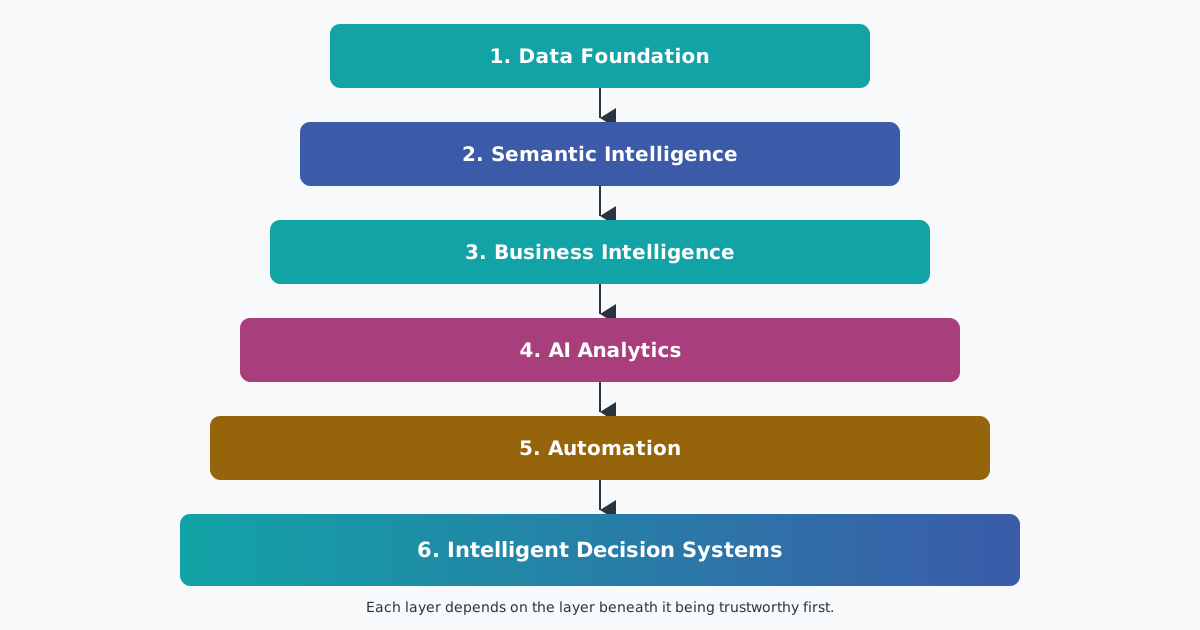
- Everything downstream - analytics, semantic models, Power BI reporting, AI, automation - inherits the trust level of the data foundation underneath it.
The More-Data Myth
The instinct when decisions feel slow or uncertain is to add more: another data source, another integration, another dashboard that promises to finally show "the real number." It rarely works, because volume was never the constraint.
A business can have terabytes of clean, well-structured data and still make bad decisions if three teams calculate "revenue" three different ways, or if nobody owns the definition of "active customer" well enough to settle an argument about it. Conversely, a business with a modest but well-governed dataset can move faster and with more confidence, because everyone is arguing about strategy instead of arithmetic.
More data adds surface area. It doesn't add agreement. Agreement has to be built deliberately, and it's a different kind of work than collecting more data ever was.
Three Reasons More Data Doesn't Mean Better Decisions
Fragmentation
Every new tool a company adopts - a CRM, a marketing platform, a finance system, a product analytics tool - tends to become its own island of truth. Each one calculates its own version of shared metrics using whatever logic was convenient inside that tool. Nobody designed this outcome; it's just what happens when ten teams solve ten local problems with ten separate tools and no shared layer connecting them.
Ungoverned definitions
Even inside a single BI tool, the same business term often gets redefined every time someone builds a new report. "Active customer" might mean "purchased in the last 30 days" in one dashboard and "has an open account" in another. Both are defensible definitions. Neither is wrong. But when they coexist without anyone tracking which is which, every number in the business becomes negotiable, and every meeting starts with a definitions argument instead of a decision.
No clear ownership
Data needs an owner the way a codebase needs a maintainer. Without someone responsible for what a metric means, how it's calculated, and when that calculation is allowed to change, definitions drift silently. A finance analyst tweaks a formula to fix an edge case in March; by September, nobody remembers the change happened, and the year-over-year comparison is quietly wrong.
Why This Problem Gets Worse Once AI Is in the Mix
Natural-language AI features - asking a tool a plain-English question and getting an answer, a chart, or a generated calculation back - are now built directly into mainstream BI platforms. Gartner's May 2026 research on semantic layers found that a lack of consistent semantics is a primary driver of inaccurate AI agents and wasted spend, and projected that most agentic analytics projects built without a consistent semantic layer will fail by 2028 (Gartner, retrieved 2026-09-18).
That finding lines up with the mechanism, not just the statistic. An AI feature doesn't invent business logic out of nowhere - it queries whatever logic already exists in your data and reporting layer. If that layer has three competing definitions of "revenue," the AI doesn't referee between them. It picks one, states it with total confidence, and moves on. The output looks exactly as polished whether the underlying number is right or wrong.
That's the actual risk of adding AI on top of a fragmented foundation: it doesn't correct the fragmentation. It reports it back to you faster, in a more convincing format, to more people at once - and because the answer arrives instantly and reads as authoritative, it's easy to mistake speed and polish for accuracy.
A Quick Way to Tell If This Is Your Problem
Three questions tend to surface the issue faster than any audit:
- If you asked three different teams for last quarter's revenue number right now, would they match? Not roughly - exactly, to the definition.
- Could someone new to the company find a written definition of your five most-reported metrics, or would they have to ask around and get five slightly different answers?
- If a number looked wrong in a report tomorrow, is it clear whose job it is to investigate it - or would it bounce between teams before anyone owned it?
A "no" to any of these isn't a crisis. It's just a sign that the foundation work hasn't happened yet, and that any AI or automation initiative layered on top of it right now would be building on the same gap.
What a Real Data Foundation Actually Includes
A data foundation, in practical terms, is the work that happens before analytics and reporting even start: consolidating scattered sources into one place, defining the business terms everyone will use, assigning clear ownership for what those definitions mean and when they're allowed to change, and building the pipelines that keep all of it current without manual patchwork.
None of that is glamorous. It's also the only part of the stack that every later layer depends on. A well-designed semantic model can't fix data that was never reconciled upstream. A well-built Power BI report can't fix a semantic model that doesn't exist yet. And an AI feature can't fix any of it - it just inherits whatever state that foundation is in and acts on it immediately.
That's the throughline for how ClarusIQ approaches this: Analytics & AI Strategy comes first, specifically to figure out where a business actually sits on that dependency chain before recommending anything downstream. Data Foundation work follows directly from that assessment, because skipping it is where most data and AI projects go wrong - not from a bad tool choice, but from building reporting or AI on ground that was never leveled.
Where to Start
If dashboards in your organization already disagree with each other, or if an AI rollout is on the roadmap and nobody's confident the underlying data would hold up to it, the honest first question isn't "which AI tool should we pick." It's "would our current data survive being queried by one."
That's a specific, answerable question, and it's the one worth answering before committing budget to anything built on top of it. If you want a second set of eyes on where your organization sits on that question, a data-foundation readiness assessment is a reasonable, low-commitment place to start.
Next in this series: why two dashboards, built from the same underlying data, can show completely different numbers - and why fixing each report individually never actually solves it.