

AI Can Answer Your Questions. Automation Is What Acts on Them.
By Day 5, Copilot can reliably answer a question, provided the semantic model underneath it is governed the way Days 3 and 4 described. That's a real milestone. It's also not the end of the story, because a correct answer sitting in a chat window still needs someone to notice it, decide what it means, and do something about it.
That gap, between getting the right answer and acting on it, is where automation comes in. Today is about what that actually looks like on the stack this series has been building, and why it only makes sense to add once everything underneath it is trustworthy.
Key Takeaways
- A correct AI answer doesn't act on itself. Someone (or something) still has to notice it and decide what happens next, and that gap is exactly what automation closes.
- Automating on top of an ungoverned model doesn't fix the underlying problem. It just automates being wrong, faster and at greater scale.
- Microsoft Fabric's Activator watches data streams and triggers actions, including Power Automate workflows, when a defined condition is met, without anyone having to check a dashboard manually, per Microsoft's own documentation.
- Fabric's operations agents can watch data, reason about what's happening, and recommend or take action, with those actions scoped, audited, and reversible by design rather than unchecked, per Microsoft's own documentation.
The Gap Between Insight and Action
A Copilot answer, even a perfectly correct one, is still just information sitting in front of one person at one moment. If that person is busy, on vacation, or simply doesn't check the report that day, the insight doesn't act on itself. A dip in conversion rate that Copilot could explain accurately at 9am does nothing on its own until someone reads it, understands it, and decides to respond.
That gap existed before AI too, dashboards have always required a human to look at them, but AI narrows the first part of the gap (getting to a correct answer) without touching the second part (turning that answer into action). Automation is what closes the second part, and it only makes sense to build once the first part is actually reliable.
Picture a hypothetical, illustrative version of this: a retail operations team asks Copilot every morning which stores are running low on a fast-moving product, gets a correct, well-formatted answer, and then manually emails the three regional managers who need to reorder. The AI layer is working exactly as intended. The actual bottleneck is now entirely human: whether someone remembers to ask the question, reads the answer carefully, and sends the email before the stockout actually happens. Nothing about a better AI model fixes that particular gap. Only something that acts on the answer does.
What Automation Actually Looks Like on This Stack
Three mechanisms, in order of how directly they touch the semantic model this series has been building.
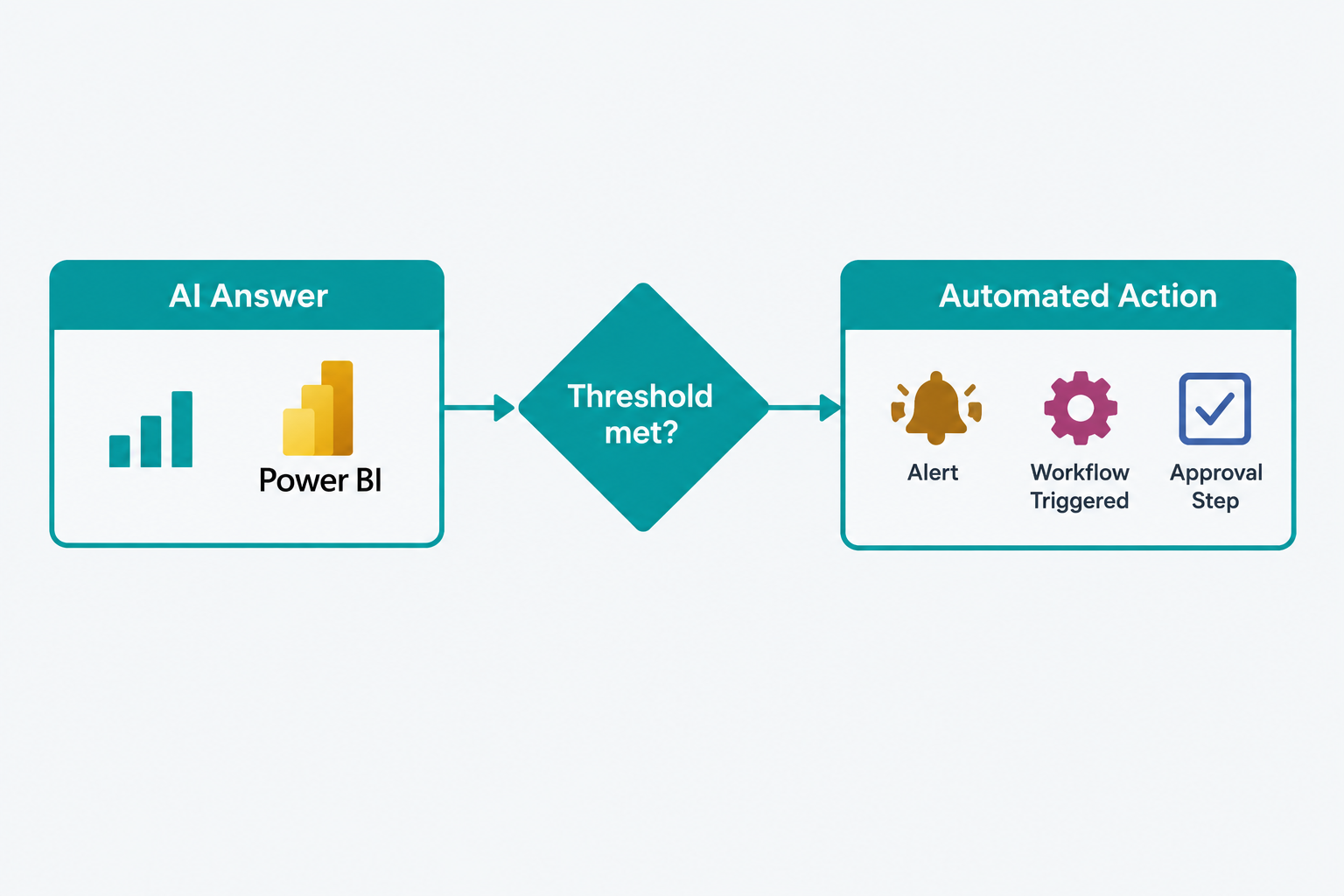
Alerts and triggers. Fabric's Activator monitors data streams and can watch values across many rows at once, not just a single aggregate number, triggering an action for any row that meets a defined condition. That trigger can call a Power Automate flow directly: sending a notification, updating a record, or kicking off a business process (Microsoft Learn). This is the simplest form of automation on this stack: the semantic model already has a governed measure, Activator watches it, and a threshold crossing triggers a response instead of waiting for someone to check a report.
Write-back from reports. Translytical task flows let a user act directly from a Power BI report, resolving a data issue or updating a value without leaving the report or filing a separate request, using governed, secure write-back into the underlying Fabric data source rather than an ungoverned side channel (Microsoft Learn). This is the insight-to-action gap closing inside the same interface where the insight appeared, instead of forcing a handoff to a different tool. Before this kind of write-back existed as a governed feature, closing that gap usually meant a separate ticketing system, a spreadsheet someone updated manually, or an email chain, each one another place a number could drift from the semantic model's actual definition.
Agent-driven action. Fabric's operations agents go a step further: they watch data, reason about what's happening using an LLM when a condition is met, and generate a recommendation. Critically, that recommendation is scoped, audited, and reversible by design, a user can approve, reject, or, once trusted, let a specific rule run autonomously without further confirmation each time (Microsoft Learn). That approval step is the difference between automation and a black box, and it's worth treating as a feature to preserve deliberately, not a limitation to remove as soon as possible.
The three mechanisms aren't competing options, they're a natural escalation path. Most organizations are better served starting with alerts and triggers on a small number of already-certified measures, moving to translytical write-back once a specific report-level workflow proves repetitive enough to justify it, and reserving agent-driven autonomous action for the narrow set of decisions where the cost of a delayed human response is genuinely higher than the cost of an occasional wrong automated one. Skipping straight to the most autonomous option because it sounds the most impressive is its own version of skipping ahead, the same failure mode Day 1 opened this series with, just at the automation layer instead of the data layer.
The Ordering Warning
Here's the part worth being direct about. None of these three mechanisms improve anything if the measure they're watching was never governed in the first place. An Activator trigger built on an uncertified, inconsistently defined metric doesn't become more trustworthy by firing automatically, it just fires confidently on a number that was already wrong, and now nobody has to notice before it takes effect.
This is Day 1 and Day 2's thesis playing out one more layer downstream. Adding automation to a fragmented, ungoverned data foundation doesn't fix the fragmentation. It removes the one thing that was still catching the problem: a human pausing to look at a number before acting on it. Automation is a multiplier, and it multiplies whatever it's given, a governed measure gets acted on reliably, and an ungoverned one gets acted on wrong, reliably.
That's why this section sits at Day 6, not Day 1. Every layer before it (data foundation, semantic model, Fabric architecture, Copilot readiness) exists specifically so that automation has something trustworthy to act on by the time it's introduced.
There's a practical test for whether a given measure is actually ready for this. Ask whether the team would trust an automated action taken on that number without a human double-checking it first. If the honest answer is no, that's not a reason to add more review steps around the automation, it's a signal that the measure itself hasn't earned the trust yet, and the work that's missing is upstream, back at Day 2 or Day 3, not a more elaborate approval workflow bolted onto Day 6.
Where This Fits
At ClarusIQ, this is Applied AI work extending into Automation: once a semantic model is certified, architected correctly, and Copilot-ready, wiring Activator triggers, translytical write-back, or scoped agent actions on top of it is a natural next step, not a separate initiative competing for attention.
The scoping question is narrower than it sounds. It's not "should we automate everything," it's "which two or three governed measures, if they crossed a threshold today, would genuinely change what someone does next." That's a short, specific list for most organizations, and it's the right starting point rather than automating broadly and hoping the important cases are covered.
That conversation usually starts with an inventory rather than a tool decision: which measures are already certified and stable enough to automate against, which are close but need one more round of governance work, and which shouldn't be automated at all yet because the underlying definition is still contested. Sequencing the rollout in that order, certified measures first, tends to produce a small number of automations that a team actually trusts, rather than a large number they quietly route around.
If you want to talk through where automation actually fits in your roadmap, given what's already governed and what still needs to be, that's a conversation worth having before any specific tool gets chosen.
Next in this series: what does a business look like once all six of these layers, data, semantic model, architecture, AI, automation, and the decisions they inform, are actually working together.