

What an Intelligent Business System Actually Looks Like
This week started with a specific claim: more data doesn't make a business smarter, trust does. Six posts later, that claim has turned into a full, connected framework, not six separate topics that happened to get covered in the same week, but one dependency chain where each layer only works because the layer beneath it is solid.
This piece puts the whole thing in one place. If you're reading only this post, you'll get the complete picture. If you've read the other six, this is where they connect.
It's worth being explicit about why a single connected framework matters more than six good individual ideas. Gartner's May 2026 research on semantic layers projected that most agentic analytics projects built without a consistent semantic layer will fail by 2028, not because any one layer was poorly executed, but because the layers weren't treated as dependent on each other (Gartner, retrieved 2026-09-18). That's the exact risk this framework is built to avoid: treating data, semantic modeling, architecture, AI, and automation as five separate initiatives that each get evaluated on their own merits, instead of one system where each layer's success is capped by the layer beneath it.
Key Takeaways
- An intelligent business system is six layers deep: data foundation, semantic model, Power BI and Fabric architecture, Copilot and AI, automation, and the decisions all of it is meant to inform.
- Each layer inherits the trust level of the layer beneath it. AI doesn't fix a bad data foundation, and automation doesn't fix a bad AI answer, they both just act on whatever they're given, faster.
- Most organizations' real bottleneck sits lower in this stack than they assume. Teams evaluating AI tools are often actually one or two layers underprepared, at the data or semantic-model layer, not the AI layer itself.
- Gartner's 2026 research frames this explicitly: modern BI platform choice is now an enterprise architecture decision, because semantic models provide the common business context that powers reports, apps, and Copilot with the same trusted definitions, per Microsoft's own account of that recognition.
The Six Layers, In Order
1. Data Foundation
Why more data hasn't made your business smarter made the opening argument: adding dashboards and data sources doesn't fix decision-making by itself, because the real bottleneck is trust, not volume. Fragmentation, ungoverned definitions, and unclear ownership are the three specific reasons more data doesn't translate into better decisions, and every layer above this one inherits whatever state this layer is actually in.
2. Semantic Model
The real reason two dashboards never agree showed the visible symptom: the same metric, calculated differently by different teams, producing numbers that are each correct by their own definition and still don't match. What a semantic model actually is named the fix: a governed translation layer where measures, relationships, and naming are defined once and reused everywhere, instead of recreated per report.
3. Power BI and Fabric Architecture
Where semantic models actually live in Microsoft Fabric and Power BI placed that governed layer architecturally: built on OneLake, often using Direct Lake mode to query data without duplicating it, and organized by business domain so it's actually reused across reports instead of quietly forked per report, which recreates the semantic-model problem inside a modern architecture.
4. Copilot and AI
Why Copilot in Power BI is only as trustworthy as the semantic model underneath it covered the mechanism: Copilot queries the semantic model, it doesn't reason freely over raw data, which means AI readiness is really semantic-model readiness wearing a different name. Row-level security, verified answers, and AI-specific preparation all sit on top of the same governed foundation, they don't replace it.
5. Automation
AI can answer your questions. Automation is what acts on them closed the loop between a correct AI answer and an actual action: alerts and triggers, governed write-back from reports, and scoped, auditable agent-driven action all become viable once, and only once, the answer they're acting on is reliable.
6. Intelligent Decisions
The point of all five layers beneath it. A decision made with a number everyone trusts, arrived at quickly, and acted on without a two-day delay, is what the other five layers exist to produce. It's not a separate technical layer to build, it's the outcome the other five are for.
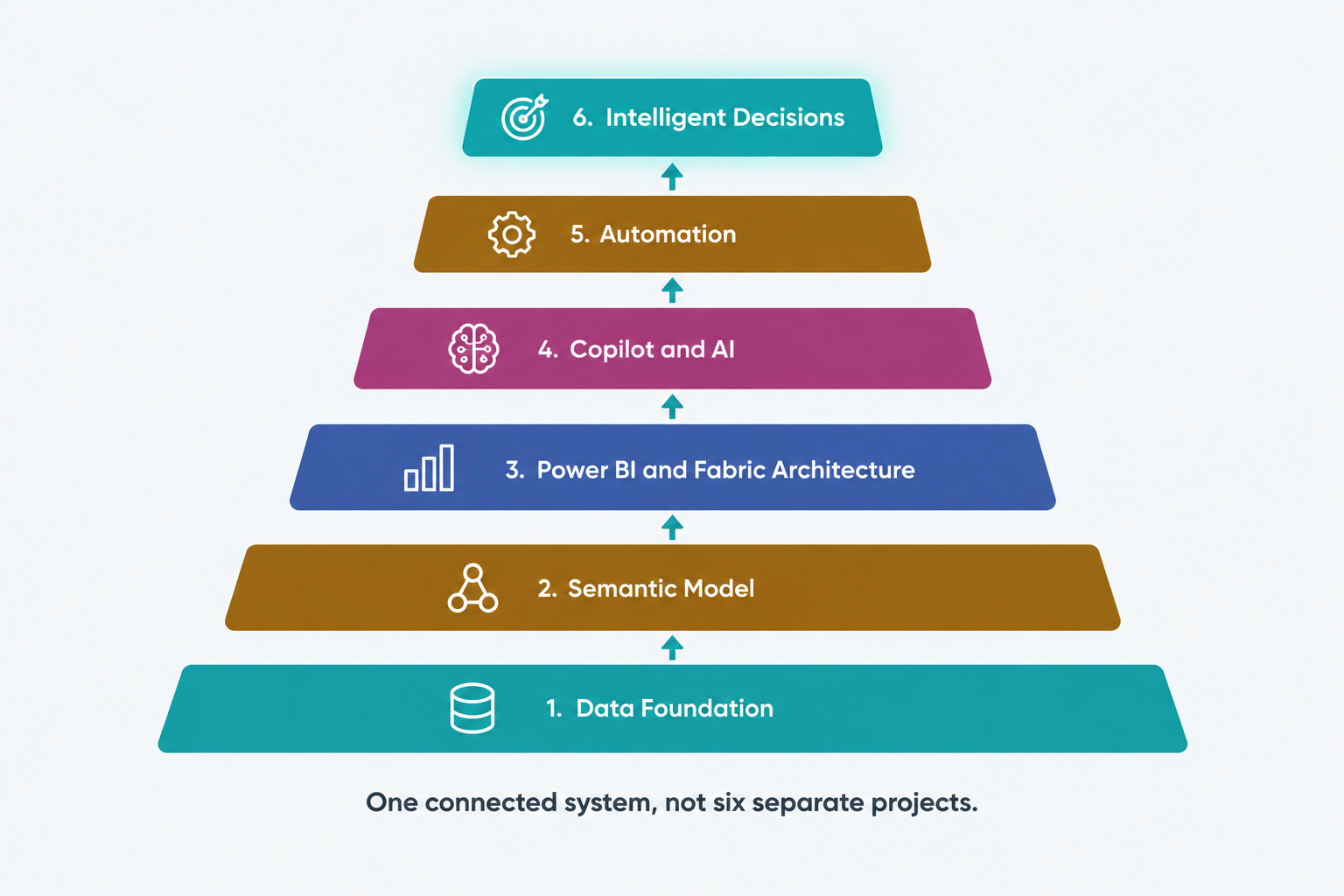
Why Skipping a Layer Doesn't Skip the Dependency
The failure mode this whole series has circled is always the same shape: an organization evaluates the top of the stack (which AI tool, which automation platform) without checking whether the layers underneath can actually support it. Gartner's own 2026 guidance frames this as an architecture decision now, not a tool-selection exercise, because a modern BI platform doesn't just display data, it defines the context data is interpreted and governed in, and that context is what ends up powering AI experiences too (Microsoft Fabric Community).
Skipping a layer doesn't remove the dependency, it just hides it until something built on top of the gap fails visibly. A Copilot rollout on an ungoverned model doesn't fail because Copilot is bad. It fails because layer 2 was never actually solid, and layer 4 inherited that gap at full speed. The same is true one level further: automation built on an unreliable AI answer doesn't fail because the automation platform is bad, it fails because layer 4 wasn't ready when layer 5 got added on top of it.
Microsoft's own guidance for BI solution architecture inside a Center of Excellence makes a similar point structurally, not just philosophically: it treats visibility into data lineage, business logic maintenance, and governance as prerequisites for a solution architecture to scale, not optional documentation to backfill once something's already live (Microsoft Learn). That's the same ordering principle this series has argued for all week, just framed as an internal governance function instead of a content narrative. An organization that skips straight to picking an AI tool without first establishing that kind of oversight is, in Microsoft's own framing, skipping a step the architecture assumes exists.
A Self-Assessment: Which Layer Is Your Actual Bottleneck
This isn't a lead-generation quiz, it's a genuinely useful five-minute exercise. Answer honestly, in order, and stop at the first "no":
- Data Foundation: If three people pulled the same metric right now, would it match, exactly, to the definition?
- Semantic Model: Does that metric exist as one certified, documented, owned measure, or does each report recalculate it?
- Architecture: Is that semantic model organized by business domain and actually reused across reports, or does each new report quietly get its own?
- AI: If Copilot answered a question using that model today, would you trust the answer under scrutiny, without checking it first?
- Automation: If an action were triggered automatically off that model's data, would you trust it to fire correctly without a human double-check?
Wherever the first "no" lands is the actual bottleneck, not necessarily the layer where the symptom is most visible. A team frustrated with "AI accuracy" that stops at question 1 or 2 doesn't have an AI problem yet. They have a data-foundation or semantic-model problem that AI is simply making visible faster than a dashboard would have.
This ordering matters because it changes what gets funded first. An organization that identifies question 4 as its actual stopping point (data and semantic model are solid, architecture is reasonable, but nobody fully trusts a Copilot answer yet) is genuinely ready to invest in AI-specific preparation: schema simplification, instructions, verified answers. An organization that stops at question 1 or 2 and jumps straight to an AI vendor evaluation anyway is about to spend budget on a layer that can't yet support what's being built on top of it, and the resulting rollout will surface the same data-trust problems Day 1 and Day 2 described, just with an AI vendor's name attached to the disappointment instead of the actual cause.
ClarusIQ's Role Across the Stack
ClarusIQ's four service areas map directly onto this framework, in the same sequence it's built in. Analytics & AI Strategy is the assessment above, done properly: finding out exactly where an organization's real bottleneck sits before recommending anything downstream of it. Data Foundation work follows directly from that finding, consolidating and governing what layer 1 needs. Power BI Reporting covers layers 2 and 3: building the semantic model itself and architecting it correctly in Fabric. Applied AI covers layers 4 and 5: Copilot readiness and the automation built safely on top of it once the answer underneath it is trustworthy.
None of this requires starting at layer 1 if an organization has already done that work well. The point isn't that every engagement starts from scratch, it's that whatever layer is actually weak gets addressed before the layers above it get built on top of the gap. A company that already has clean data and a well-documented semantic model doesn't need a Data Foundation engagement repeated, it needs the architecture review and AI-readiness work that picks up from where it already stands.
That's also why this framework is deliberately not a product to buy or a single deliverable to hand over. It's a sequence, and the right amount of ClarusIQ involvement at each layer depends entirely on how much of that layer's work is already solid internally. Some organizations need help at every layer. Others just need one honest assessment of where they actually stand, and enough of a nudge at the one weak layer to unblock everything already built correctly above and below it.
What's Next
This series was seven posts, not the last seven ClarusIQ will publish on this topic. Future pieces will go deeper into specific parts of this stack rather than re-covering the whole arc: practical row-level security setup, a semantic model naming and certification style guide, a closer look at where agentic AI in Power BI is genuinely production-ready versus still roadmap, and industry-specific versions of this same six-layer framework. Each of those will link back into this piece and into whichever of the six posts above it extends.
That structure is deliberate. This post is meant to function as the hub of that growing set, the one place a reader can land regardless of which specific spoke brought them here, and still walk away with the full picture instead of one isolated technical detail. As more of those deeper pieces get published, this framework is what keeps them connected instead of becoming a scattered archive of loosely related BI and AI topics.
If you've read this far and already know which layer your organization's bottleneck sits at, that's a useful, specific starting point. If you're not sure, that uncertainty is itself informative, it usually means the assessment work at layer 1 hasn't happened yet. Either way, a free architecture assessment is built to answer exactly that question before anything else gets recommended.